Saturday, September 22, 2018

Hampi Badami - The Master Piece

This is a brief (!!) account of my Journey to the Southern state of Karnataka to discover the incredible ruins of medieval Hampi, the rock-cut caves of Badami and the beautiful temples of Pattadakal and Aihole. Disclaimer: A basic search on google can lead to a lot of information about these magnificent monuments and hence  I have not delved too much into the facts and history of the places

Tattva Adventures (through The 3 Wheeler Ride Travel Company - 3 व्हिलर राइड)  invites to explore Hampi & Badami on 31stAugust  2018 to 3rd September  2018 (A premium tour) was just the message which I had been waiting for past few years, from the time I heard about the Hampi Ruins from a friend.


ITINERARY:

31st August to 3rd September , 2018 .
Total Cost — 12,000/- PP + 5% GST
Includes:

Ø Traveling From Mumbai to Mumbai in Sleeper AC Coach.
Ø Private AC vehicle for Sight Seeing all days.
Ø Accommodation in AC Rooms. (Triple Sharing basis) in 3/4 star hotels
Ø 3 Breakfast.
Ø All Monument Fees & Taxes.


DAY 1 : Friday — 31st august

The adventure quotient of the trip started much before the trip even started , because it was actually cancelled and then replanned since the majority of those who had earlier confirmed for the trip had changed their mind and opted out. So it was just two of us Myself and Priya (my niece and regular travel buddy).  The adventures continued at stage Zero. We assembled at Sion  @ 4.30 pm & boarded the bus to Hospet. It’s a 15hrs journey overnight by bus. (AC SLEEPER COACH).
 Imagine our surprise when after just a 30-minute drive we stopped, only to be told that the Bus had developed a technical snag. And the bus driver also informs us that he has run out of diesel !!!! (this, at the beginning of a fifteen-hour trip)

Replacement bus arrived at 10 pm. For those familiar with the peculiarities of Mumbai traffic, the replacement Bus had to come from Borivali to Wadala (Bus Terminus) !!! The spillover of the late start reflected in both the mandatory late-night dinner break and the arrival at the destination getting delayed by over five hours.


Day 2. (Hampi) Saturday — 1st September

Krishna, our designated local guide was available at Hospet to receive us at around 1p.m. and after a much needed yet quick bath and lunch break at Hotel Clarks Inn, Hampi we started our Excursion to the famed Hampi Ruins.

A two-member group size ensured we could take advantage of the resultant flexibility and we opted for an auto-rickshaw for travel rather than by  Pvt AC vehicle as originally planned. (Talk about soaking in the local flavour!!) . Venkatesh having replaced Krishna as the local guide for the day cum Saarathi 

Colourfully painted frescoes on the walls brightened up the quiet town of Hampi. And there were monuments practically every few km.


 For the History/mythology enthusiasts, Hampi (the modern name for the ancient Kishkinda)  is nestled within the ruins of the medieval city of Vijayanagar in the state of Karnataka, on the banks of the Tungabhadra river. Set in a surreal and beautiful boulder-strewn landscape, Vijayanagara (the City of Victory) is a UNESCO World Heritage Site and although the city was destroyed by marauding Moghul invaders in the 16th century, much of it remains today. Credit definitely to the ASI and Local administration which has done a good job of maintaining the monuments.
There are some magnificent Ancient ruins that are spread over 26 sq km area, many of which lie in and around Hampi Bazaar and the nearby riverside area. East of Hampi Bazaar is the UNESCO-listed 16th-century Vittala Temple, the undisputed highlight of the ruins. The Vitthala Temple is Hampi’s crowning glory.  The iconic magnificent stone chariot standing in the courtyard, which has been made famous by tourists posing with the new Rupees Fifty note is just one of the magnificent piece of sculpture in the Complex.
 
The entry fee levied by the Archaeological Survey of India definitely play a significant part in the maintenance of the Monuments. Reasonably priced at Rs.40/- per person, the ticket literally transports the visitor into a different plane and era. I really cannot speak for others, but I definitely got a feel of what the atmosphere must have been in years of ore. Occasional exposure to Bollywood ‘period’ movies did their bit in helping me visualize too :D

Missed seeing the large Ranga Mantapa with its 56 Musical Pillars (restricted for tourists now). The few Youtube VDOs of the musical pillars just whetted the appetite further to see and listen to the same but it was not to be 


 As expected, there was an electric vehicle ride from the main gate to the interior of the Vijaya Vittala Complex. This apparently is a recent move to ensure less pollution (sound and gas) in the immediate vicinity of the ancient precious monuments. For the records (as of September 2018 ) the cost of a single trip by the electric vehicle was Rs.10/- . Entirely operated by Female uniformed drivers, there was heartening sense of discipline to the whole thing.

It was nice to see many uniformed staff, security and others stationed at vantage points within all the Complexes to ensure discipline.
After a pleasant couple of hours soaking in the feel of the place, we moved onward to the next wonder.
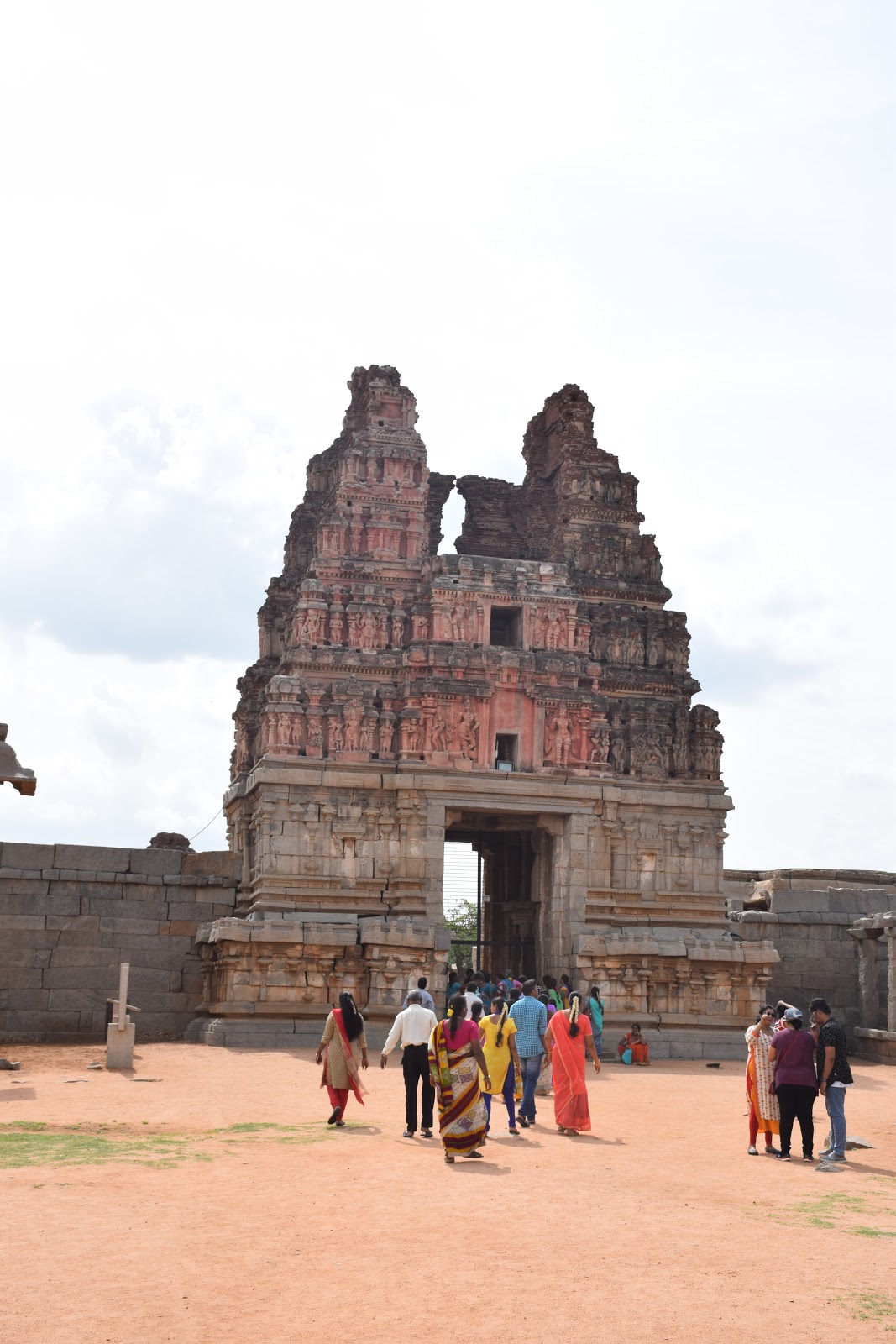
The visit to the Royal Enclosure comprising of (Queen’s bath, Mahanavami Dibba, King’s Audience Hall, Stepped Tank, and Public tank), Hazara Rama Temple, and Zenana Enclosure (Basement of queen’s palace, Lotus Mahal, Elephant’s stables, and watchtowers) was awe-inspiring. 


It was quite easy to get transported a few Centuries back and imagine how it must have been in the Olden days at the Prime of the condition and the activities of the Royalty of that time.
The Elephant stable was an imposing edifice with arched entrances and many domes that must have once housed the magnificent state elephants.


The visually appealing Lotus Mahal  , an elegant example of the Hindu and Muslim styles of architecture which derives its name from its beautifully symmetric arches which resemble the petals of a Lotus opening to the Sun
The Hazara Rama Temple , the royal temple reserved for ceremonial use had some breathtaking carvings of horses, elephants, dancing girls and soldiers.


The magnificent 6.7m high awesome monolith Lakshmi  Narasimha depicting the man-lion form of Lord Vishnu and the adjoining  Badavi Linga which were on the way from Royal enclosure to Virupaksha temple was an awesome experience. . . . It was at this point that Mother Nature decided to enhance our experience further and it started drizzling lightly. The Fabulous ancient sculptures with light rains and the smell of wet earth were altogether a  Divine experience. 


The drizzle steadily increased in force and by the time we got back to our trusted steed – THE AUTO, it was pouring cats and dogs. The downpour resulted in us missing Virupaksha Temple and the Monolithic Bull. 

We did however find shelter from the weather at a quaint Café serving magnificent Coffee :)


We also missed seeing the Mustard and Peanut Ganesha ( Sasuvekalu  and Kadalekalu Ganeshas).  It was pretty late and that was it for Day 1 of sight seeing (Remember we started the day five hours late !!!)


Day 3 (Badami) Sunday 2nd September

We started off the day nice and relaxed with a long Car ride (opting out of the Auto ride because of distance about 150kms from Hampi to Badami.)  Subramanian, our trusted Sarathi cum guide for the day reassured us that a start of 10 am was good enough for the sightseeing planned. This was quite contrary to the opinion of our Mumbai operator Jigar and our Hotel reception manager who were quite insistent that we should leave early in the day in case we wished to cover Badami exhaustively. The sightseeing and exploration for the day started with Aihole. Subramanian told us there are around 125 ancient temples in Aihole all scattered throughout the village. So, we had assumed that we would need more time to visit the temples in Aihole. It was not a very happy sight to see the condition of Aihole village which was highly underdeveloped. There were many small temples all around the village which all belonged to 6th to 8th centuries. But, the roads leading to them were very bad. We really are not doing justice to our past glory by not maintaining them well. 
                      
Our actual destination was Durga temple. This temple is the most popular among all the temples in Aihole. The temple complex is huge and beautiful. As informed by Subramanian and cross verified with Ms.Google,  Durga temple was also constructed by Chalukyas during 7th-8th century and it is unique in design. The interesting part is that Durga temple is not dedicated to Goddess Durga. It is dedicated to either Shiva or Vishnu. The name originated from “fortress” (in Kannada, Durga means “fort”). The architecture style is predominantly a combination of Dravidian and Nagara style. The pillared corridor makes the temple look magnificent.     
The temple has beautiful carvings on the walls and on the ceiling. Each and every corner of the temple speaks the glory of our ancestors.
Aihole Museum
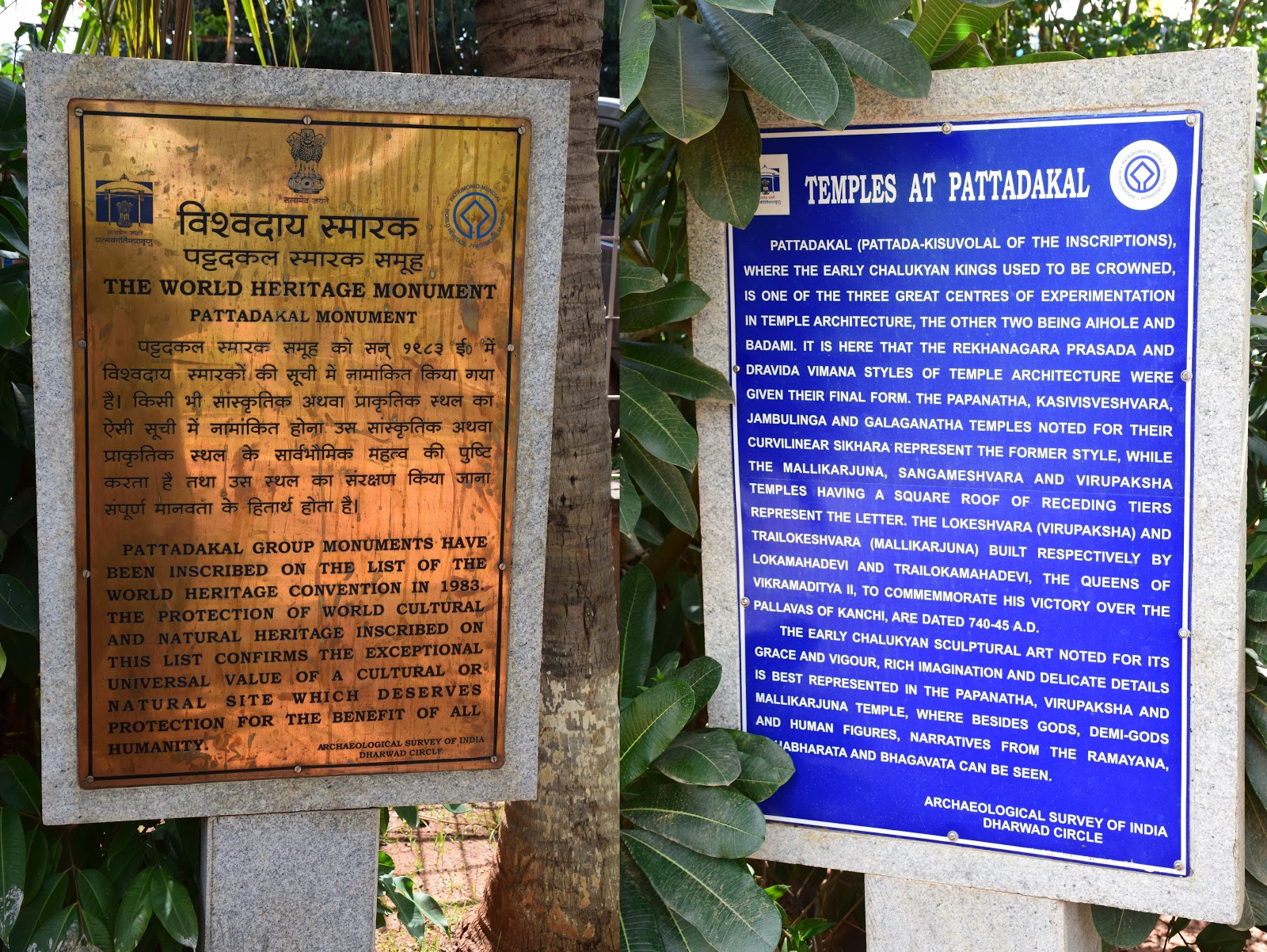
Next on the agenda was Pattadakal . Situated 13 kms from Aihole  ,and  around 22 km from Badami, Pattadakal group of monuments is one of the UNESCO World heritage sites in India. When I was planning for this trip, amongst all the places, I was attracted more to Pattadakal. As you enter the gates of Pattadakal group of monuments, you will become captivated with the beauty in front of you. The heritage site is maintained extremely well and the group of temples looks outstandingly wonderful as you walk towards them. In ancient times, Pattadakal was a site where Badami Chalukya kings were coronated and it has temples built by them during 7th and 8th centuries. The group of monuments at Pattadakal is located on the left bank of the river Malaprabha and it has 10 temples including a Jain sanctuary. The temples were built in different architectural styles including Rekha, Nagara (Northern) and Dravidian (southern) styles. As per information and Boards put up at the Complex, this was as good as a Experimental project / pilot project  for the Kings and they tried out all styles of architecture here.
The temples in Pattadakal temple complex are Virupaksha Temple, Sangameshvara Temple, Chandrashekhara temple, Mallikarjuna Temple, Kashivisvanatha Temple, Galaganatha temple, Kadasiddhesvara temple, Jambulingeswara temple, Jain temple and Papanatha temple. Each temple is extremely beautiful. The Virupaksha temple is the largest among all, Sangameshwara temple is the oldest. Kashi Vishwanatha temple was built by Rashtrakutas and this temple is in a typical Nagara style and the gopuram of this temple is fascinating. The group of these temples is an absolute treat for the eyes. The feeling when we regretfully came out of this magnificent complex was one of leaving behind something unfinished. That is when I realized, these magnificent structures are not something that you can just see and move on. They are to be experienced at leisure. Considering our duration of three days in this region and so many unvisited places, I was certainly left wondering as to how Tour operators take out one day or two-day expeditions to these Heritage sites       
Now onward to Badami where I was looking forward to be amongst the hand hewn rock Caves. History Buffs … This one is for you - (Badami) UNESCO World heritage monuments , are  best known for the  remarkable cave temples. They display the full range of Indian religious sects. Badami was formerly known as Vathapi and was the capital of Badami Chalukyas during from 540 to 757 AD. The founder of the Chalukya dynasty was Pulakesin I (535-566 AD). His sons Kirtivarma I (567-598 AD) and his brother Mangalesha (598-610 AD) were involved in the construction of the cave temples. The most powerful King among the Chalukyas was Pulakeshin II (610-642 AD) who defeated many kings including the Pallavas of Kanchipuram. Badami had seen many major wars between Chalukyas, Pallavas, Rashtrakutas. It was later occupied by Vijaynagar Empire, the Adil Shahis, the Savanur Nawabs, the Marathas and Hyder Ali before the British included it in the Bombay Presidency. It’s pretty exciting to see the monuments which are around 1600 years old.  The temples which we were going to see in this trip were built during 6th – 8th centuries !! We felt bad to see the condition of the people and the condition of such a popular place. Fortunately, the historic monuments were preserved well. Before you begin to climb the cave temples, near the parking lot, you can find beautiful Killa Masjid. The Badami cave temples are carved out of red sandstone on a gigantic hill cliff and are considered to be the example of Indian rock-cut architecture. There are four cave temples and are connected by a stepped path (Decent exercise , though the excitement does not make you feel the strain ) . For the records, we climbed to the top and covered the Caves in the descending order


. As you climb these steps, the view of the city, the nearby lake and the other monuments in the city become more and more beautiful. The first cave is dedicated to Lord Shiva. The main attraction in this cave is the carving of Nataraja with 18 arms and it is said that if you take any combination of the two arms of this sculpture, it makes a perfect classical dance pose.

            
Apart from this beautiful Nataraja, there are few other wonderful sculptures on the walls as well as on the ceiling of the temple. If you climb around 60 steps, you will reach the second cave temple which is dedicated to Lord Vishnu and in this temple Vishnu is depicted as Trivikirama – with one foot on earth and the other foot directing to north. There is also a representation of Vishnu as Varaha. 
This cave is the biggest among the four cave temples of Badami. The panoramic view of Badami town and Agasthya lake is extremely beautiful from this temple.

We climbed some more steps to reach the last cave temple which was dedicated to Mahaveera Jain. 
This temple was the last constructed cave temple and was not as beautiful as the other three temples. There was an old Kannada inscription at the pedestal which belonged to the 12th century.
Late evening we enjoyed the sunset on the way back to Hampi covering the Banashankari Temple .  The trip to Badami would never have been complete without a visit to the famed Banashankari temple . Located at Cholachagudd near Badami, in Bagalkot district, Karnataka, India.

The temple is popularly called Banashankari or Vanashankari since it is located in the erstwhile Tilakaaranya forest. The original temple was built by the 7th century Kalyani Chalukya kings, who worshipped goddess Banashankari as their tutelary deity.
 The temple celebrates its annual festival called Banashankari jatre, in the months of January or February. The festival comprises cultural programmes, boat festival as well as a Rath yatra, when the temple goddess is paraded around the city in a chariot.
  It was interesting to experiment with the local sweet tea and evening snack Girmitt at a restaurant close to the Temple.


The long car journey from Hampi to Badami and back had some melodious Rehman Jukebox giving us soothing company . Throughout the day, Subramanian lived up to his promise of ensuring we covered all places. His speedometer read at an average of 100kmph !! En route back to the Hotel, We saw a Huge bungalow, resembling a palace being constructed on the way and  we were provided with the interesting tidbit that it belonged to a local ex Councilman with a colorful history.
Also it was fun to see a very interesting strategy by young children at almost all village borders to cordon off the Road and ask for Donations for the soon to come Ganapati Chaturti celebrations.

Day 4 (Hampi) Monday 3rd September

The day started with a long auto ride from Hotel to the Historic Anjan(i)  Parvath/ Anjeyanadri Hill  also known as Monkey Hill. 
Folklore has it that this is the birthplace of Lord Hanuman. Lord Hanuman is also known as Anjaneya. Hence, the hill has been given the name of Anjeyanadri. There is a temple dedicated to Lord Hanuman on top of the hill. Anjeyanadri Hill is surrounded by lovely plantain and paddy fields. There are more than 575  steps to reach the summit of the hill. Though the climb involves a large number of steps, it is quite safe to ascend the hill due to the presence of the stone stairs


A cool breeze helps visitors in their climb. But the main attraction is the view of the surrounding that the hill offers. The sight of the valley and the Tungabhadra River flowing below offers a mesmerizing sight.
After the exhilarating visit to Monkey hill, it was onward to Pampa Sarovar. Pampa Sarovar is a sacred pond for the Hindus. This is believed to be one among a few Sarovars (sacred ponds) mentioned in Hindu epics and scriptures. The pond and the shrine are located in a secluded valley hidden by boulder hills at the three sides. The pond, rectangular in shape, is usually filled edge-to-edge by floating lotus. There were however no lotuses when we visited 
   The whitewashed shrine is located right next to the pond. This is a functioning temple and the idols worshiped are of Lord Shiva & his consort Parvathi (Pampa). This shrine is much ancient than many of the temples in Hampi.
A vividly painted musical instrument placed in the temple courtyard is interesting. The instrument at a time plays a drum, metal plates and a couple of bells attached to it. The whole thing is driven by a motor attached to the mechanisms. Apparently, these were the temple musical instruments originally played by the temple musicians. Now this machine plays it all together during the prayer time (typically early morning & in the evening).


Then onward it was to the magnificent Durgadevi Temple housing a  Sri Krishna Temple and awesome Durga Lakshmi and Shiva Linga .


This complex provided some awesome photo ops since there was no obvious restriction on photography.
 Around this time , I realized that I was missing my cap. Logic stated it had to be at the auto or left behind at Pampa Sarovar. We did make the trip  back to Pampa Sarovar though not very hopefully. Lo and behold , my traveling accessory was right where I had forgotten it a goodly hour back. This was in spite of it being Gokulashtami / Krishna Janmashtami and a decent  crowd at the Temple. Gratitude for that :)


Somewhere during the course of the day, we also managed a Coracle ride in the magnificent Sanapura Lake. Must say this was very much on the “to be experienced” list before this trip :D


Chanced upon this interesting sign  “Swimming prohibited, crocodile inside” at the Lake  (after our ride) and then realized later that we were riding our flimsy Coracle in the very same Lake !!!


The day passed by quickly enough and soon we were back at the Hotel. Onward to the Bus Stop and the 15-hour journey later, it was back at Aamchi Mumbai with loads of memories. There is nothing like getting back to your everyday routine (Mumbai or elsewhere ) for a reality check :P.
Few interesting aspects of the trip were that all our guides cum saarathis (Four of them in three days )  were Tamil speaking people (in Karnataka !!! ). On enquiry, we came to know that these were descendants of those people who had settled down at Karnataka in the early 1950s after having come here as Workforce from Tamil Nadu for construction of the Tungabadhra Dam.


It was also nice to see magnificent traditional arches at the entrance of most Village Borders. I have earlier noticed this also in Maharashtra and Andhra Pradesh.


Also it is nice to see the use of local resources, in this case Stone being used for setting up a compound wall. Earlier had come across such use in Cuddappah region and also in and around Abu Road. 


Could click this beautiful Shiva/Shankara painting in the rather nice "Pink Mango" restaurant right next to Clarks Inn.

As always I am surprised at the way we comfortably cross State Borders / Zones (actually more like our own comfort zones)  (just a few 100 km)  and literally step into a different world totally different from our very own City streets, skylines, routines and crowd. This fabulous experience I guess is available to everyone who is willing to explore it. In few earlier posts too I had shared about the weekend getaways with nature. I do agree treks and marathons might not be doable for everyone, but this was more in the nature of a basic excursion/ expedition to a place with some mind-boggling History and Architecture. Will this inspire at least a few who read this to try such visits ? ?  Only time will tell. There are some magnificent experiences to be explored within India

Saturday, March 31, 2018

Annapurna circuit - Dream Trek


            In March 2018, I and my friends trekked for 11 days in Nepal’s Himalayan mountains along the Annapurna circuit trail crossing one of the world’s highest passes, Thorong-La at an altitude of 5416 metres (17,769 feet) above sea level. This is my account of the challenging trek. (It’s a bit long because of the duration of the trip and hence, request your patience.)


The Annapurna Circuit is a trek within the Annapurna mountain range of central Nepal. The total length of the route varies between 160–230 km (100-145 mi), depending on where motor transportation is used and where the trek is ended. This trek crosses two different river valleys and encircles the Annapurna massif. The path reaches its highest point at Thorong La pass (5416m/17769 ft), touching the edge of the Tibetan plateau. Practically all trekkers hike the route anticlockwise, as this way the daily altitude gain is slower, and crossing the high Thorong La pass is easier and safer. The mountain scenery, seen at close quarters includes the Annapurna Massif (Annapurna I to IV), Dhaulagiri, Machapuchare, Manaslu, Gangapurna, Tilicho Peak, Pisang Peak, and Paungda Danda. Numerous other peaks of 6000-8000 m in elevation rise from the Annapurna range. The trek begins at Besisahar or Bhulbhule/Nigdi in the Marshyangdi river valley and concludes in the Kali Gandaki Gorge. (We concluded our trek at a place called Muktinath). The trail passes along paddy fields and into subtropical forests, several waterfalls and gigantic cliffs, and various villages. Annapurna Circuit has often been voted as the best long distance trek in the world (Got to experience that first hand and can confirm the same), as it combined, in its old full form, a wide variety of climate zones from tropics at 600m above mean sea level (AMSL) to the arctic at 5416 m AMSL at the Thorong La pass and cultural variety from Hindu villages at the low foothills to the Tibetan culture of Manang Valley and Lower Mustang.

DAY 1 - Mumbai-Kathmandu and exploring Kathmandu


We started on 10th March from Mumbai.
Mumbai Airport

TIMS- Trekers Information Management System


A routine flight later, we reached Kathmandu, checked into the Hotel and the same evening, after a briefing and some mandatory paperwork by the Organizers (which basically means we sign a declaration saying organizers are not responsible for our deaths!!!), it’s off to Pashupatinath Temple, to seek the blessings of the Powerful Resident Diety of Kathmandu.
Pashupatinath Temple


A quick dinner and some trekking gear purchases later we retire early, to start the next day fresh. We also get introduced to our Guide Prem Bahadur Thapa with specific do’s and don’ts’ instructions.

Day 2 – Journey to Bhulbhule

The following day (11th Mach), Post breakfast, we start our memorable journey towards Bhulbhule through Besisahar ( 2,490 ft). We traverse by river Marshyangdi and several small mountain villages. We enjoy smooth roads up to Besisahar. Soon after, we drive across mountain terrains (read uneven tracks) as we arrive at our destination of the day, which is a picturesque village on the banks of Marshyangdi River surrounded by snow-capped mountains. We stay overnight at Nigdi Village and are given a taste of our expected boarding and lodgings for the next couple of weeks. We meet a few fellow trekkers and exchange notes. Night time brings with it fitful sleep to the accompaniment of the soft sound of bubbling water.
Accomodations


Day 03: Nigadi to Jagat (4,232 ft, about  6 hours trek  ) 12th March.


                Today Early morning, we begin our trek to Jagat through motor-able roads(Man (un)made roads - Immense Respect for the vehicle drivers) alongside  Marshyangdi River. Today's route is less straining and more picturesque as we encounter many waterfalls while gaining more altitude. The only issue being vehicles frequently making us scramble to the sides of the Roads. We reach Jagat by late afternoon. It is a small quaint village with basic amenities. We bask under the sun and explore the village. The hot water springs did sound an attractive proposition, but the approaching darkness deterred us from soaking in the same. One interesting aspect of the entire trek was that the schedule showed a different distance to be traversed and our Mobile app almost always showed nearly double of that. Which led me to compare the actual distance and the “as the crow  flies” distance which travel companies promote.


Day 04: Jagat to Dharapani (6,299 ft, in about 6 - 7 hours) 13th  March.

                For me, the day started with an upset stomach + inadequate sleep because of bedbugs !!! The target was very clear for the day - Reach the Destination and rest. Expectedly minimal breakfast and lunch made the day easier to manage. Today we trekked along the trails which offered stunning view of landscape with gushing waterfalls on the way, a hanging bridge to cross over Marshyangdi River to reach Taal. We halted at Taal for lunch and then moved onward to our final destination for the day. The route between Taal to Dharapani is very pleasant to the eyes as we surpass more than 100 waterfalls. Somewhere along the way we lose track of the number!!!!! And hence refer to the next one as N+1th Waterfall. Also, the Suspension Bridge that we crossed that day was the first of many.
                Overnight at Dharapani - By now we are getting used to the quaint Tea Houses and the double blankets that our Hosts were kind enough to provide. The good Trekking shoes that we had, saved me from several ‘ouch’ moments protecting the ankles from twists in the uneven paths.


Day 05: Dharapani to Chame (8,629 ft in about  6 - 7 hours) 14th  March . 

It was supposed to be a Rhododendron Trail. Did not get to see too many though, maybe ‘development’ is to be blamed!! We made fairly good time and convinced ourselves that our timing has improved. :D .


Day 06: Chame to Pisang (10,466 ft in about  5 - 6 hours) 15th  March .

We stayed at “Lower” Pisang and strangely enough were the only tourists at “Eco Cottage Lodge”. The day’s trek was very interesting through Pine forests, and the occasional steep ridge (which combined with the gradually increasing altitude left us breathless).  We passed through the Bryaga village and the Buddhist influence was very marked in the style of the Houses as also the benign Monastery overlooking the village. Crossing the majestic Marshyagandhi through the magnificent Suspension Bridges had almost become a daily affair. A continuous drizzle ensured that our rain gear was put to good use.

 Got to see the magnificent animals of the mountains – mountain goats in plenty and quite a few Yaks too.


One peculiarity at Pisang which the locals stoically accepted. There was no electricity in the village and surrounding areas for ten days!!! However, the solar system ensured that cooking was happening normally. And with luck even a bit of warm water for the occasional wash. 


Day 07: Pisang to Manang (11,549 ft in about  5 - 6 hours) 16th  March.


            The night was cool but clear  but the next day We woke up to snow all around


   chance to charge the Electronic equipments  and some much needed leisure.


There was an interesting library to be raided too  at the Tilocho Hotel where we stayed. 

The rest day also gave the opportunity to wash clothes for all those who were inclined to do so.


One interesting aspect of the day’s trek (Pisang to Manang) was when we had to navigate across a landslide prone region and we did it gingerly yet quickly one by one under the able guidance of Prem.

Day 08: Rest day in Manang 17th   March. 

Today we are free to take rest and get energized for the next day’s ardour. Our Guide Prem’s idea of rest is to go for a ‘short trek” on the Hills. We chanced upon the Magnificent Gangapurna Lake and got used to the super slippery ice paths. My fellow trekkers had already done more than their share of homework by way of googling extensively and were frequently dropping the figures of AMS cases, slips, falls, and the notorious sub-zero temperatures all along the trip while reminding about the insurance cover with helicopter airlift included. The slippery climb and descent along the narrow paths suddenly gave a whole new dimension of what to expect the next few days of Trek.


Day 09: Manang to Yak Kharka (13,484 ft in about   4 hours) 18th   March.

Yak Kharka brought with it magnificent views of the Annapurna 2,3 and 4 peaks as also the Gangapurna peak. I don’t think we ever will get over the feeling of being dwarfed amidst the massive peaks. The excitement was gradually building up as we gained height every day.


Day 10: Yak, Kharka to Thorong Phedi (15,092 ft, 3 – 4 hours) 19th March. 

We reached Thorong Pedi early enough and after a quick lunch proceeded to trek to a height of about 150+ metres and returned back. Trek high and sleep low is a mantra which most trekkers follow. This is to enable the body to get used to the higher altitudes that it will be encountering.


Day 11: Throng Phedi to Muktinath (12,467 ft, 8 - 9 hours) 20th. 

Forgive the slightly longer narrative style here. This day was the highlight of the entire trip and had to be described accordingly.
            It was an ice-cold night. It had snowed slightly the previous night turning the panoramic mountain peaks into humongous white monsters. In the freezing early hours of the day, we were due to wake soon to climb the highest navigable (on foot) mountain pass in the world, Thorong-La. Sleep was fitful not only because of the biting cold but also because of the anticipation. Our base camp was at 4400 metres, and when you are this high acute mountain sickness is to be expected. Visions of helicopter evacuations kept floating in front of my eyes. The week-long climb to this point had been challenging, but it was nothing compared to the day that lay before me, and I knew it. For the first time during the hike I was just a little bit scared. The reality that I was not an experienced trekker, but a budget backpacker seeking a new thrill weighed on my mind and I tried to not let it psyche me out. When our guide gave us the wakeup call at 1.30 a.m., it was a relief from the nervous sleeplessness. We piled on the layers of clothing and got (mentally and physically) ready for the long day ahead. As it was an unearthly hour, there was no chance for a comforting tea before heading out into the freezing darkness. Guided only by headlights, which dotted the climb like stars, each person made their own way up to first steep ascent of the day. Cold hands and breathing were the hardest things early on, but we all found a comfortable pace and the first couple of hours passed by without any cause for concern, in fact, I felt confident and ready to tackle whatever lay ahead. 

            As we climbed further, paces slowed – and continued to slow to nothing more than a crawl. We took a much-needed break at an abandoned wood cabin and also managed a small fire to warm us up a bit. Water in our normal bottles had frozen. The steel flask ensured we got a swig of hot water too; to drink whatever water hadn’t yet frozen was a task in itself.  I have been and always will be a doer rather than a thinker and the continuous enquiries from my fellow trekkers about distance remaining to be climbed only served to distract me. I estimated about 200 metres to climb upwards to reach the Thorong-La – I’d never been so close, yet I felt a million miles away.  Each person I was trekking with was enduring their own personal struggle. Conversation had completely died down and we were just plodding along. 

            “There it is!” Dr.Swamy  shouted ahead. “I can see the flags!”
Our guide Prem had some sense of humour and had kept the sight of the signboard and flags hidden until we were practically stumbling into them. Time 7.45 a.m. and mental maths showed we had trekked for 5 hours and 45 mins to ascend 1200m AMSL. The euphoria of the moment is very difficult to describe, it has to be experienced. We were able to spend 30 minutes soaking in the moment . Pics, videos, much hugging and more pics and the inevitable ginger lemon tea from a Tibetan man who made a living serving expensive tea to overjoyed hikers at the pass each day. Sipping hot chai in that moment was odd bliss and I couldn’t wipe the smile from my face.

            For the first time in more than a week we were going down – my body was crying out for lower altitude, and I wasn’t going to deny it any longer. I stood in front of the fluttering Tibetan prayer flags one last time before starting the descent. They say mountains talk to you. I think I know what they mean now. Inspite of our eagerness to reach the Pass, we were still lucky to chance upon the spectacle of the Golden Rays of the Sun kissing the tops of the Mountain Ranges just few 100 meters below the Pass. The time must have been around 6.50 a.m. at that time.


 Soon it was time to descend.

For the first time in more than a week we were going down – my body was crying out for lower altitude, and I wasn’t going to deny it any longer. I stood in front of the fluttering Tibetan prayer flags one last time before starting the descent.  They say mountains talk to you. I think I know what they mean now. Inspite of  our eagerness to reach the Pass, we were still lucky to chance upon the spectacle of the Golden Rays of the Sun kissing the tops of the Mountain Ranges just few 100 mtrs below  the Pass . The time must have been around 6.50 a.m. at that time.


From there, we started descent  towards Muktinath, which is considered to be a sacred place for both Hindus and Buddhists. The majestic Dhaulagiri Ranges stretched in front of us in all splendors. The descent from Thorang La Pass to Muktinath after the exhilarating ascent was slow and torturous. Blame our inexperienced feet on slippery ice !!!!! Without exception all of us including Prem (our Guide) had our slide, whoosh and  Thud moments. Thankfully no injuries to any one.  The descent though brought with it much needed lower altitudes and easier breathing to our Oxygen starved lungs.  After a lunch break at Thorang Pedi where my friends felt adventurous enough to try Sea Buck Thorn Juice (!!!)  , we proceeded towards Muktinath and finally reached the Hotel there around 5 p.m.  -  a grueling 16 hours after waking up at.
Overnight stay in Muktinath was in a decent Hotel and we gratefully crashed into our beds after the coffee and a hot shower (Shridhar and me opting to skip dinner and waking up next morning directly  after a 11 hour long rest ) .  The two doctors explored the Muktinath Temple to seek Blessings for all .
Unanimously , we dropped the day trek from Muktinath to Jomson in favour of a direct drive to Pokhra.  The original plan of Flight from Jomson to Pokhara altered because of the unfavourable weather at Jomson.
21/3 to 23/3  – Muktinath to Pokhara and then onward to Kathmandu : Man proposes and God Disposes!!!  In this case our drive through mountainous Nepal’s non existent roads ensured we spent several hours on the road. In fact more number of hours than what we would have spent  , if we had trekked. We drove  through, Jungle trails, road blocks and  inhospitable weather.

Our Bus developed a technical snag providentially near a Tea House where we spent the night.


 Next day started early as our onward journey commenced at 4 am and after breaks for tea and breakfast we reach Pokhara by 11am. Overnight at Pokhara and Pokhara to Kathmandu and then the short flight back to Aamchi Mumbai brought the eventful trip to an end. At Pokhara , we had an interesting luncheon tete a tete with Everest trekker Lakpa Tsheri Sherpa - National Geographic adventurer of the year 2012. Lakpa is an Eight time Everest Summiter !! and a Paragliding Champion . He also is a Discovery Channel  Cameraman for High Altitude shoots. He had some very interesting experiences to share. Can’t thank our Guide Prem enough for this awesome unexpected bonus.


Few random notings which deserve special mention -
·          One peculiarity of Forex dealers in entire Nepal, no one has any exchange rate for INR but everyone accepts INR at 1.6 conversion factor!!! Another peculiarity – International Debit card with “RuPay” network not accepted in any place .
·          There are no rules for the weather in the mountains. Over the 11 days trek we had gorgeous sunny days with temperatures up to 20C degrees and then days below freezing temperatures, the lowest was a chilly -14C degrees (this was close to the Thorong-La Pass above 5,000 m/16,404 ft).
·          You can’t drink tap water unless you have an iron stomach!! So what are your options? There is always mineral water available to buy, but 3-4 plastic bottles of water a day, that’s not great for the environment or the pocket . What you can do is buy some water purification tablets or Chlorine drops  (Chlorivatt)  and have water for the whole journey, easy solution.

·          Also, another water issue is that when the temperature drops (this was only on the ‘Pass’ day) it tends to freeze. Even otherwise on most days temperature of the water is more like refrigerated water
·          HOW MUCH NEPALESE MONEY SHOULD YOU TAKE FOR THE ANNAPURNA TREK?
·          ATMs in the mountains? Nope, you’ll be disappointed because there aren’t any and also as you climb higher the costs do tend to rise. Now don’t panic because everything is pretty cheap to start with but you will notice prices rising during your trip so just make sure you have enough. Shridhar , the experienced trekker in our Group had cleverly opted for our Group to have a meals included tariff  and that proved to be a major factor in keeping our out of pocket expenses well under control.  I took NR 20,000 (about INR 15000) which was sufficient for me.
·      Along the entire Annapurna trek, you’ll come across various sacred  Buddhist monuments. Known as Stupas; many of them with prayer wheels, as per the picture below.  The correct way of walking past these is always on the left-hand side or clock wise while rolling them with your right hand.


If you’re lucky enough to have porters, which we did, then just remember to pack wisely. I tried lifting one of the bags our trusty porters were  carrying (about 30kg); I could lift it, I even did a few steps but I could not imagine carrying that weight all the way. Kudos to our Porters – Mohan and Bhim . Mohan incidentally , like most young Nepalis is a Die hard fan of Bollywood and Tollywood Movies and was reeling off names and humming filmy numbers whenever opportunity warranted.
The two on the extreme right are Bhim and Mohan , the porters.
One another surprising aspect was - Almost every teahouse we stayed in  had Wi-Fi !!! Again the further away from civilisation you walked it went from being free to a maximum of INR 100 for  24 hours. Sometimes the connection wasn’t too great, but then ... hey we were in the mountains so what do you expect!!!!! The charging of even Mobile phones or Battery packs became payable at Higher altitudes. Cost of water as we ascend – NR 150/- (from NR 30 at lower ranges)

Several times during the narration I have mentioned about the importance of good Shoes. It would not be out of place here to mention that we had a few fellow trekkers comfortably overtaking us in basic floaters !!!!
Elsewhere in another post (http://itsmevaidy.blogspot.in/2017/02/chadar-trek-2017-experience-of-lifetime.html) I had mentioned about “Kadmon mein padam” i.e. earnings in each step  . . .  Got plenty of opportunity for experiencing the same in this trek too.

Another interesting point, We did not chance upon any Indian Trekkers during the entire two weeks. Our guide Prem, later told us that Indians favoured the more popular Everest Base Camp (EBC).

It was wonderful having the Company of Dr.Ramesh Raman (Ramesh) , Dr. Narayanaswamy  (Swamy) and Krishnamurthy (aka Shridhar ) . Shridhar’s colourful anecdotes ( and Surya breaks) , Swamy’s stoic demeanour and never dying enthusiasm for capturing the memories and moments in his Camera , Ramesh’s  mind boggling ability to keep reeling off the Technical details and of Course Prem (our Guide’s) perpetually smiling face and patience with our pace are things which will stay with me for a long time.  Having four Tambrams in the Trek group ensured that we spoke and discussed more Tambraminical stuff than what we would do in a entire lifetime. Palakkad Slang and  MMKR dialogueswere standard fare throughout the trip. Looking forward to the next one soon. Will it be Kilimanjaro in January 2019 ? ?  Time only will tell J


Couldn't resist posting this pic with the Map on our Tees :) 

Tibetan Bread was a standard fare for Breakfast

Nepal mein Biscuits bhi Trekker's choice !!!!!! 

Honest Notes From the Road

  🌍 Honest Notes From the Road I’ve learned that being honest about travel doesn’t mean being negative. Saying “this city wasn’t as magi...